Popular Temples

Shri Avanti Parshwanath Jain Shwetambar Tirth- Ujjain

Shri Avanti Parshwanath Jain Shwetambar Tirth- Ujjain
🕉️
Main Deity
Please visit temple website
Contact
* Temple/Office: +91 75665 85854
Full Address
Chandrashekhar Azad Marg, Danigate, Ujjain, Madhya Pradesh - 456006, India.

Main Deity

Bhagwan Avanti Parshwanath: A black-colored idol of Lord Parshwanath in the Padmasana (lotus) posture, approximately 120 cm (47 inches) high, featuring a beautiful umbrella of seven-hooded snakes.

Other Deities (Sub Deities)

While Avanti Parshwanath is the Moolnayak (primary deity), the complex and surrounding management area include:

  • Bhagwan Adinath (Rishabhdev): Located in one of the oldest temples in the city (part of the larger Ujjain Tirth cluster).
  • Manibhadra Veer: A newly constructed temple dedicated to this protector deity (Yaksha) is within the premises.
  • Dada Guru Dev: There is a Dadawadi (shrine dedicated to Jain Gurus) located directly opposite the main temple.

Opening & Closing Timings

Temple Hours: Generally 05:30 AM to 11:00 PM daily.

Entry Fees

There is no entry fee to visit the temple or offer prayers. Donations for the upkeep of the Tirth are voluntary.

Location- How to Reach/Commuting- Flight/Train/Bus/Taxi Stand/Ferry/Port Air- what ever is available?

  • By Air: The nearest airport is Devi Ahilyabai Holkar Airport, situated about 55–60 km from Ujjain. From the airport, taxis and buses are easily available to reach the city.
  • By Train: Ujjain Junction railway station is the nearest railhead, located approximately 1.5 to 2.5 km from the temple. Auto-rickshaws and e-rickshaws are readily available outside the station for local travel.
  • By Bus: Ujjain is well connected by regular bus services from nearby cities such as Indore, Bhopal, Ahmedabad, and Jaipur. The main bus stand is around 2–3 km from the temple.
  • Local Transport: Within Ujjain, commuting is convenient through auto-rickshaws, e-rickshaws, and app-based taxi services like Ola and Uber.

Special Poojas/ rituals being performed: provide the Days & Timing of these Poojas. What are the rates associated with it? What is the advance booking procedure?

At the Shri Avanti Parshwanath Jain Shwetambar Tirth, rituals follow the traditional Shwetambar Jain system.

Daily Ritual Sequence
  • Morning begins with Samuhik Prarthana (early hours)
  • Followed by Pakshal / Abhishek (ritual cleansing of the idol)
  • Moolnayak Abhishek performed after the initial rituals
  • Snatra Puja conducted later in the morning
  • Anga Rachana (Angi) performed in the afternoon (idol decoration)
  • Aarti and Mangaldeep are held in the evening.
Days and Timings

These rituals are generally performed daily

Exact timings may vary slightly depending on the temple schedule and season

On festivals like Paryushan and Mahavir Jayanti, rituals are more elaborate and extended.

Advance Booking Procedure for Pooja/Rituals

  • Mode of Booking: There is no automated online portal for ritual bookings. You must contact the Trust Munim (Manager) directly. This ensures that a Pujari (priest) is assigned and the necessary Samagri (ritual materials) are prepared for your specific timing.
  • Official Contacts: To initiate a booking, call
  • Office: +91 75665 85854
  • Landline: 0734-2585854.
  • Required Information: When calling, you must provide the date of the pooja, the type of ritual (e.g., Snatra Pooja, Ashtaprakari Pooja, or sponsorship of the evening Angi), and the number of family members participating.
  • Timeframe: For standard rituals like a Snatra Pooja, a minimum of 2-3 days advance notice is sufficient. For large-scale events or rituals during major festivals (like Paryushan or Dashami), it is highly recommended to book 7–10 days in advance.
  • Confirmation & Payment: While you can block the date over the phone, the booking is traditionally finalized upon arrival at the Tirth. You must visit the ground-floor Munim Office to pay the "Bhakti Ni Rakam" (donation) and collect a formal stamped receipt. This receipt is your authorization to perform the ritual in the temple.

Types of Rituals You Can Book

  • Snatra Pooja: A detailed ritual celebrating the birth-bath of the Tirthankara. This usually takes about 1.5 to 2 hours.
  • Angi Seva: Sponsoring the elaborate evening decoration of the Moolnayak idol with sandalwood paste and jewelry.
  • Kesar Pooja / Pakshal: While an individual daily Pakshal (morning bath) does not require a booking, if you are bringing a large group (Sangh), you should inform the manager so they can manage the flow of devotees.
  • Aarti/Mangal Divo: Sponsorship for the main evening lamps can be requested in advance, though for some specific days, it may be decided via a symbolic bidding (Ghee Boli) on the spot.

Any specific Dress Code prescribed for entry to the place - men /women/for spl puja and festival days?

For Men

  • General Entry (Darshan): Modest traditional or formal clothing is suggested. This includes a Kurta-Pyjama or a formal shirt and trousers.
  • Avoid wearing shorts, bermudas, three-quarters, sleeveless vests, and t-shirts with offensive graphics or caps.
  • For Special Pooja/Pakshal (Touching the Idol): You must wear Pujan Kapde (dedicated ritual clothes). This consists of a clean, unstitched cotton Dhoti and Upasane (Dupatta), usually in white, yellow, or saffron.
  • Purity Rule: You cannot wear any stitched clothing (including undergarments) beneath the dhoti when performing Pakshal or Kesar Pooja. The clothes must be freshly washed and not worn to the washroom or outside the temple premises.

For Women

  • General Entry (Darshan): A Saree or Salwar Kameez with a proper Dupatta is the standard. It is expected that the head remains covered while inside the main sanctum or during the Aarti.
  • Special Pooja & Festivals: A Saree is highly preferred and often mandatory for major rituals. Prohibited: Jeans, western dresses, short skirts, sleeveless tops, or transparent attire are strictly prohibited and will result in denied entry to the prayer hall.

Are Electronic Gadgets allowed? Which all? If mobile/gadgets are not allowed where it can be deposited in or near the temple premises?

  • Mobile Phones: Generally allowed inside the temple premises (courtyards/open areas), but they must be kept on silent or switched off. Use of mobile phones inside the Gabhara (Inner Sanctum) is strictly prohibited.
  • Photography & Videography: This is strictly forbidden inside the temple, especially of the main idol (Moolnayak). In Jainism, photography of the deity is considered a disturbance to the spiritual energy and sanctity of the idol.

Where to Deposit Gadgets

If you are carrying gadgets that are not allowed or you don't wish to carry them during darshan, here is where you can store them:

  • Temple Trust Office: There is a management office near the main entrance. You can usually deposit your phone or a small bag here. They may provide a token system, especially during busy festival days.
  • Dharamshala Lockers: If you are staying at the Avanti Parshwanath Dharamshala (located within or adjacent to the Tirth), it is safest to leave all electronic gadgets, chargers, and cameras in your locked room or the safe lockers provided by the dharamshala management.
  • External Cloakrooms: Since the temple is located near Dani Gate, which is a high-traffic area close to other major temples (like Mahakaleshwar), there are several private Clock Rooms or locker services in the market area that charge a nominal fee (approx. ₹10-₹20) to store mobile phones and bags.

Is Photography allowed? If yes, any fee prescribed?

Main Sanctum (Gabhara): Photography of the Moolnayak Bhagwan Avanti Parshwanath idol is strictly prohibited. This is a religious rule across almost all Shwetambar Tirths. You may take photographs of the temple architecture, the external carvings, and the Dharamshala area for personal use. There is no fee for photography.

Is there a LIFT/ Elevator or any other facility for the physically handicapped?

Yes, there is a functional lift (elevator) facility available. The lift primarily serves the Dharamshala building, allowing elderly and physically challenged devotees to reach their rooms on higher floors comfortably. The main prayer hall is located on the ground/elevated level. While there are a few steps to reach the main platform, the staff and management are very helpful in assisting those who cannot climb.

Facility of WheelChair for elderly and physically challenged?

Wheelchairs are available on-site for the use of elderly and physically challenged visitors. You can request a wheelchair at the Security Desk or the Trust Office near the main entrance. This facility is provided free of charge as a service to the devotees.

Special entry/ Special Timing of Darshan for Sick/ Senior Citizens/ Physically Challenged persons?

There is no separate fast-track queue, all devotees follow the general Darshan schedule (5:30 AM - 11:00 PM), but if the temple is crowded, you can approach the Trust Office or the Pujari (Priest). They typically allow senior citizens, the physically challenged, or the sick to move ahead or provide them a stool/chair to sit and perform Darshan or Chaityavandan peacefully.

Is Vehicle Pooja Performed. If yes what time? Cost?

Vehicle pooja is not performed, but you may bring a vehicle to the entrance for Vasakshep (holy sandalwood blessing) by the priest. There is no fixed cost, though a voluntary donation to the temple trust is customary. It is best to arrive between 7:00 AM and 10:30 AM to ensure priest availability and manageable parking in the narrow lanes.

Does the temple provide accommodation facilities to the pilgrims? If yes, what are the types of such facilities?What is the cost? How to book in advance?

The Shri Avanti Parshwanath Jain Shwetambar Tirth provides modern, clean AC and Non-AC rooms with attached bathrooms specifically for Jain families. These accommodations are very affordable. Alongside an attached Bhojanshala serving traditional Jain meals. Advance bookings can be made through the official website www.avantitirth.com or by contacting the management directly at +91 75665 85854.

What is the parking place for those who come by 4 cars, mini bus and two wheelers ?

Parking at the Shri Avanti Parshwanath Jain Shwetambar Tirth is somewhat limited due to its location in the narrow lanes of the Dani Gate area in Ujjain. While a small amount of space may be available near the entrance for two-wheelers, it is often congested and not suitable for long-duration parking. For cars, minibuses, or larger vehicles, direct access and parking near the temple are not feasible. Visitors are advised to use designated public or private parking areas near Mahakaleshwar Temple or along Hiramill Road, which are located approximately 1 to 1.5 km away. From these points, e-rickshaws and auto-rickshaws are readily available and provide the most convenient means of reaching the temple, as they can easily navigate the narrow streets leading up to the site.

Temple Prashad services- Meals- procedure, payments if any, different class/lines? How to buy the ticket, if needed and timings?

Meals at the Shri Avanti Parshwanath Jain Shwetambar Tirth are served through a traditional Bhojanshala, where simple and sattvic Jain food is prepared in accordance with dietary rules, including the exclusion of root vegetables. Pilgrims can avail meals by obtaining a coupon from the Bhojanshala counter or the temple office on arrival. The contribution for meals is nominal, and the system is uniform, with no separate categories or priority lines; devotees are served collectively in a common dining space. Meal timings are generally fixed: breakfast (Navkashi) in the morning, lunch around midday, and dinner (Chovihar) served before sunset, in keeping with Jain practices that avoid eating after dark.

Seating is usually arranged in a traditional row system (pangat), though basic seating support may be available for elderly visitors. For larger groups, it is advisable to inform the temple administration in advance so that arrangements can be made accordingly..

What is the procedure for reporting items lost in a temple?

At the Shri Avanti Parshwanath Jain Shwetambar Tirth, visitors can follow these steps if an item is lost:

  • Inform the Temple Office: Report the loss immediately at the temple office or management desk
  • Provide Details: Give a clear description of the item. Mention the last known location and approximate time.
  • Check with Staff: Temple staff may help check the surroundings or common areas. Recovered items are sometimes kept safely at the office.
  • Share Contact Information: Provide your name and phone number. This helps staff contact you if the item is found later
  • Follow Up: Revisit or contact the office after some time to check updates
  • Inform Local Authorities (if required): For valuable items like wallets or mobile phones, report to the nearest police outpost in Ujjain.

Is this temple registered under the state govt/ District administration? Provide if the information is visible on the site?

The Shri Avanti Parshwanath Jain Shwetambar Tirth is managed by the Shri Avanti Parshwanath Jain Shwetambar Murtipujak Marwadi Samaj Trust and functions as a registered public religious institution. In Madhya Pradesh, such trusts are governed under the Madhya Pradesh Public Trusts Act, 1951, and fall under the jurisdiction of the District Administration in Ujjain. The temple’s registered status is indicated through the use of (Regd.) alongside the trust’s name in official materials. This information is also reflected on the temple’s official website, avantitirth.com.

How can one make Donations, (apart from Hundi offerings in the temple) to whom and which bank account and for what all purposes?

The Shri Avanti Parshwanath Jain Shwetambar Trust accepts formal donations via cash, cheque, or bank transfer for purposes like Dev-Dravya (temple upkeep), Bhojanshala (meals), and Jivdaya (animal welfare). To ensure security and receive an official receipt, you must contact the office at +91 75665 85854 to verify their current bank details before transferring funds. Always avoid paying private individuals or unverified online links, as the trust only operates through official institutional accounts.

Provide the history and architectural significance and scientific construction of the temple

The history of this Tirth is nearly as old as Ujjain itself, dating back over 2,500 years. It is intimately linked to the story of Avanti Sukumal, a wealthy merchant’s son who embraced Jain monkhood and attained salvation through immense penance. His son, Mahakal, constructed the original temple in his father’s memory, which is why ancient texts often refer to it as the Mahakal Chaitya. For centuries, the temple served as a primary spiritual hub in the kingdom of Avantika, particularly flourishing under the patronage of King Samprati, often referred to as the Jain Ashoka, who renovated the shrine to its former glory.

The most famous historical event associated with this site involves the great scholar-monk Acharya Siddhasen Diwakar during the era of King Vikramaditya. Legend states that while the Acharya was reciting the Kalyan Mandir Stotra, the Shivalinga in the temple (which had been established there during a period of Shaivite influence) split apart at the 11th verse. The original, magnificent black idol of Bhagwan Parshwanath miraculously emerged from within the Shivalinga, re-establishing the site’s Jain identity.

Architectural Significance

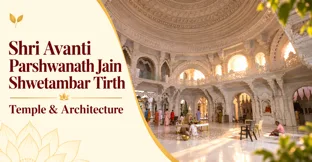
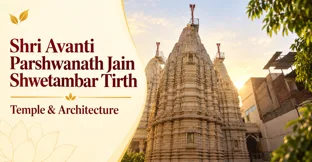
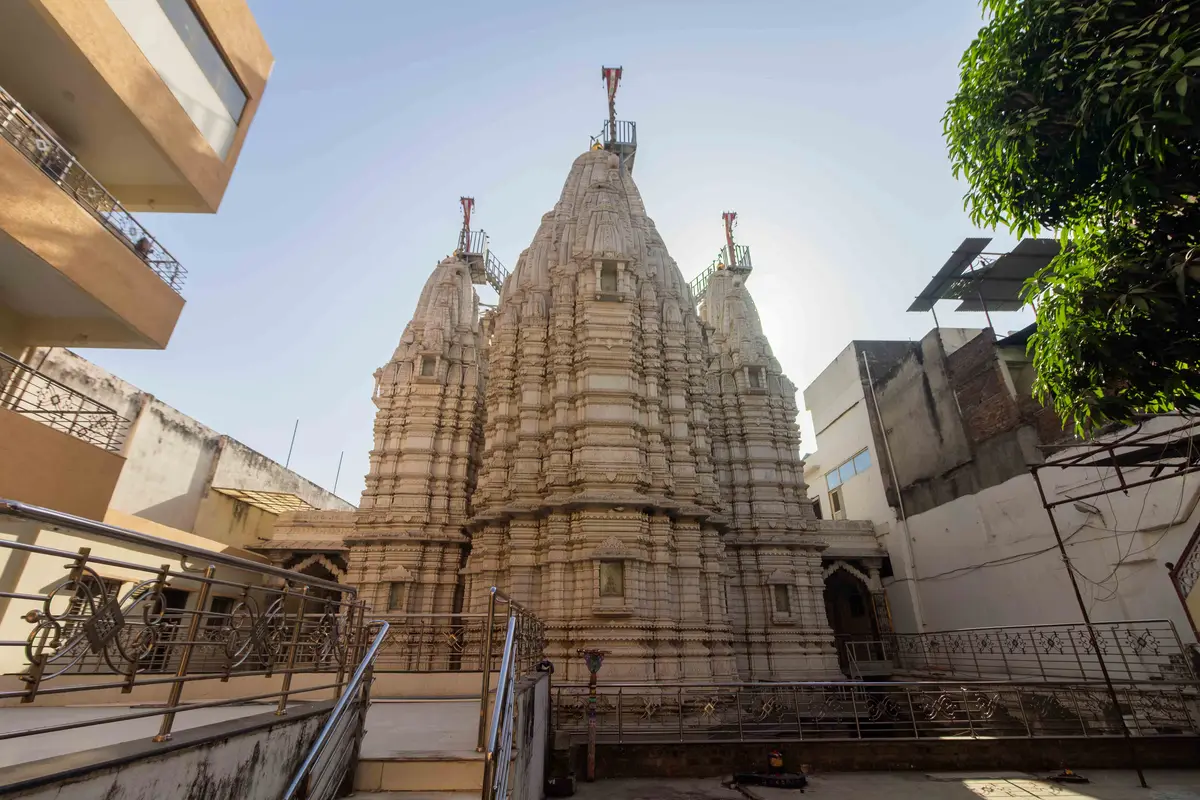
The temple is a masterpiece of Maru-Gurjara architecture, characterized by its intricate marble carvings and towering Shikhara (spire). The central attraction is the Moolnayak idol, a 120 cm (approx. 4 feet) high statue of Lord Parshwanath carved from polished black stone. The deity is seated in the Padmasana posture, shielded by a beautifully detailed seven-hooded serpent umbrella. The temple complex is also renowned for its vast hall and the collection of 108 Parshwanath idols, each uniquely named, making it a vital stop for pilgrims completing the 108 Parshwanath Yatra.

The external walls and the Mandapa (assembly hall) feature pillars adorned with celestial figures, dancers, and floral motifs carved into white marble. The recent renovations in the mid-18th century and late 20th century have preserved the ancient aesthetic while reinforcing the structure. The temple’s layout is designed to guide the devotee from the mundane world into the spiritual silence of the inner sanctum through a series of increasingly ornate gateways.

Scientific Construction and Engineering

The construction of the Tirth adheres to the principles of Vastu Shastra and ancient Indian engineering, which prioritize longevity and environmental harmony. The temple is built using an interlocking stone mechanism, largely avoiding iron clamps to prevent rust and structural expansion that could crack the marble over centuries. The use of high-thermal-mass marble and a high-vaulted ceiling ensures that the internal temperature remains significantly cooler than the outside air, providing a naturally ventilated environment conducive to long hours of meditation.

Scientifically, the Gabhara (Sanctum) is designed with specific properties; its domed ceiling reflects sound waves toward the center, allowing the low-frequency chanting of "Om" and Jain Mantras to resonate and create a calming vibratory field. Furthermore, the orientation of the temple and the placement of its windows are calculated to allow natural sunlight to illuminate the Moolnayak idol at specific times of the day, reducing the need for artificial lighting while highlighting the stone's natural luster and the intricate details of the carvings.

Information which a foreigner would like to know- focussing more on spirituality rather than religion.

A Sense of Transition- As you enter the Shri Avanti Parshwanath Jain Shwetambar Tirth, simple practices like removing footwear or washing hands and feet create a subtle shift. It feels like leaving the outside rush behind and stepping into a quieter, more focused space.

Calm Through Space and Design- The use of white marble, symmetry, and clean surroundings creates an immediate feeling of calm. The space feels organised and uncluttered, which naturally helps the mind slow down.

Stillness as an Experience- The image of Parshwanath in deep meditation is striking in its stillness. Instead of showing action, it reflects quietness, allowing visitors to pause and reflect inward rather than look for something external.

Shared Atmosphere- Even without understanding the language of chants, visitors can sense a collective calm in the space. The focus of the people present feels inward, creating a peaceful and steady environment.

Connection with Natural Rhythm- Visiting during evening aarti or quieter hours highlights a connection with the natural flow of the day. Light, sound, and timing come together in a way that feels simple and grounding.

Call to action or interaction links- here in it could be for:

a. Puja( as and when we tie up) or link to the puja facility on the temple web site( back linking)

b.Donation ( link)

c.Accomodation - here link to our site where we have listed accommodation of all types with an enquiry form

d.Exemption available under Income tax act - 80G etc for the donation made. For eg. Donation to the Anna dana at Shirdi is eligible for 100%/50% exemption.

Call to Action & Interaction

Annual Event of the temple day and date

  • Parshwanath Janma Kalyanak: Celebrated on Pausha Krishna Dashami (usually Dec/Jan); features grand processions and Snatra Mahotsav.
  • Paryushan Parva: The most significant 8-day period of fasting and reflection, occurring in Bhadrapada (Aug/Sept).
  • Navapad Oli: A nine-day festival of semi-fasting and special Poojas held twice a year (Chaitra and Ashwin months).

Monthly Event of the temple- day and date

  • Poonam (Full Moon): A day of special prayers and increased footfall; many devotees observe a fast or visit for special Darshan.
  • Snatra Pooja: Performed on auspicious lunar dates like Kalyanak days or every Sud Dasham (10th day of the bright fortnight).
  • Bhakti Sangeet: Musical devotional evenings held on Saturday nights or during the Chaturmas period.

Experience Divine Darshan

Immerse yourself in the spiritual essence of this sacred temple through our 360° VR experience.

Download Divya Darshan 360 App