

Why devotees come here
The Kalachuri temples at Amarkantak, in Anuppur district of Madhya Pradesh, were built between the 10th and 13th centuries. The Archaeological Survey of India protects the group for its historical and architectural significance. The town is also the birthplace of the Narmada, Son and Johila rivers.
The name Amarkantak is said to mean 'immortal source'. The sacred landscape here is the setting for the Kalachuri temples, which the Archaeological Survey of India now preserves.
The Kalachuri dynasty ruled from their capital at Tripuri, present-day Tewar near Jabalpur. Between the 10th and 13th centuries, their reign saw a series of temples built here. The Karna Mandir, also called Triayatana Temple, was commissioned by King Karna Dahaliya. It has three shrines built upon a single high platform, facing different directions. Despite partial damage, the central and northern shrines are well preserved. Its plan is the seven-projection Saptaratha plan, rare for the region.
The Keshavanarayana Temple is a twin-shrine complex in the five-projection Pancharatha format, dedicated to Vishnu. The Pataleshwar Mahadev Temple is dedicated to Shiva and was built by the Kalachuri king Karnadeva. Its deep-set sanctum is reached by descending steps from the raised mandapa, a rare example in the region. Door jambs and lintels carry creeper patterns and rosette motifs.
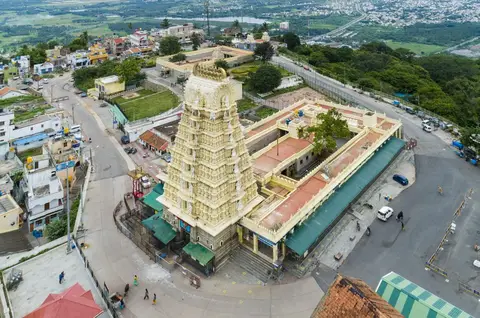 In the appChamundeshwari Temple, MysuruChamundi Hill, Mysuru, Karnataka
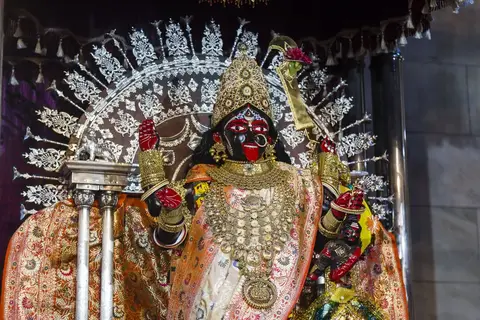 In the appDakshineswar Kali Temple, KolkataDakshineswar, North 24 Parganas, near Kolkata, West Bengal
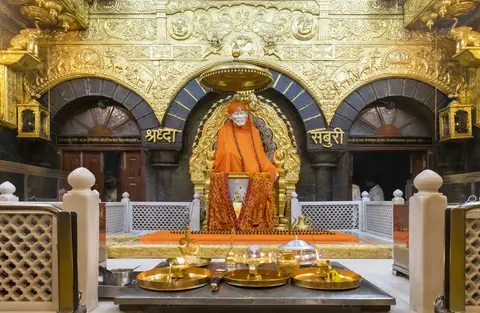 In the appShirdi Sai Baba Temple, MaharashtraShirdi, Rahata taluka, Ahilyanagar district, Maharashtra
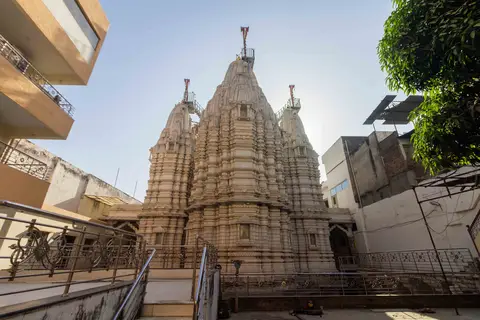 In the appAvanti Parshwanath Jain Tirth, UjjainDani Gate, Ujjain, Madhya Pradesh
 In the appBelur Math, West BengalBelur, Howrah district, West Bengal
 In the appBrihadeeswara Temple, ThanjavurThanjavur, Thanjavur district, Tamil Nadu
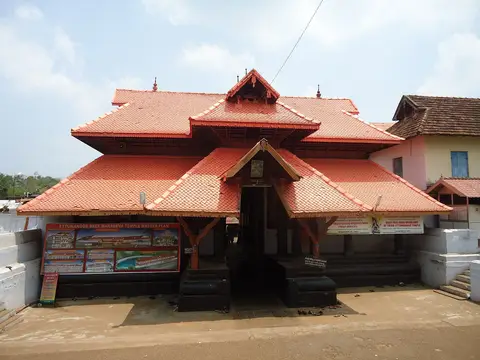 In the appEttumanoor Mahadeva Temple, EttumanoorEttumanoor, Kottayam district, Kerala