

Why devotees come here
The Trilokinath Temple stands on a cliff at 2,760 metres, about 9 km from the village of Udaipur in Lahaul and Spiti district. The white-painted shrine is sacred to Shiva, and to both Hindus and Tibetan Buddhists.
Trilokinath is one of the names of Shiva, and it means Leader of the Trinity. The temple is sacred to both Tibetan Buddhists and Hindus. Its courtyard holds large Buddhist prayer wheels, a granite lingam and a small Nandi bull. Legend says a Kullu raja tried to carry off the idol, but the stone became too heavy to move, and he was defeated.
Local tradition says the temple was first a Buddhist monastery, though nothing of that building remains. Some scholars speculate that it was first a Shiva temple, made Buddhist by Padmasambhava in the 8th century. The original columns are linked to King Lalitaditya in the 9th century. The present six-armed white marble image is attributed by some to the 12th century.
The white-painted shrine sits on a cliff at the end of a village street. The shrine has a curvilinear stone tower, called a shikhara, crowned with a segmented amalka. This style came to the region in the 7th and 8th centuries. Unlike temples on the plains, it has no pillared hall, perhaps because there was no clear ground for one.
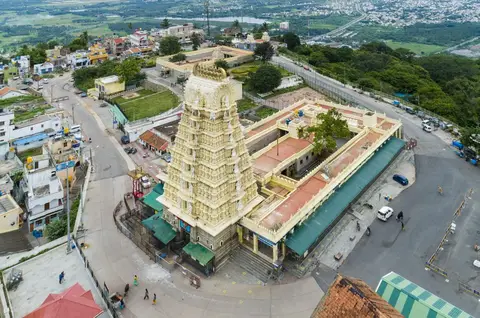 In the appChamundeshwari Temple, MysuruChamundi Hill, Mysuru, Karnataka
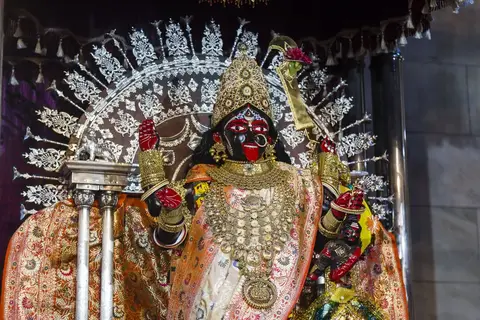 In the appDakshineswar Kali Temple, KolkataDakshineswar, North 24 Parganas, near Kolkata, West Bengal
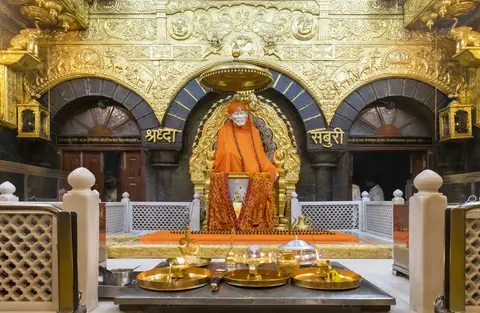 In the appShirdi Sai Baba Temple, MaharashtraShirdi, Rahata taluka, Ahilyanagar district, Maharashtra
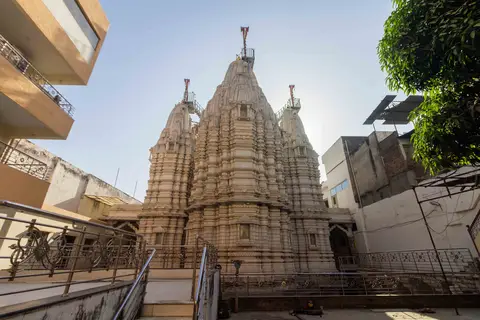 In the appAvanti Parshwanath Jain Tirth, UjjainDani Gate, Ujjain, Madhya Pradesh
 In the appBelur Math, West BengalBelur, Howrah district, West Bengal
 In the appBrihadeeswara Temple, ThanjavurThanjavur, Thanjavur district, Tamil Nadu
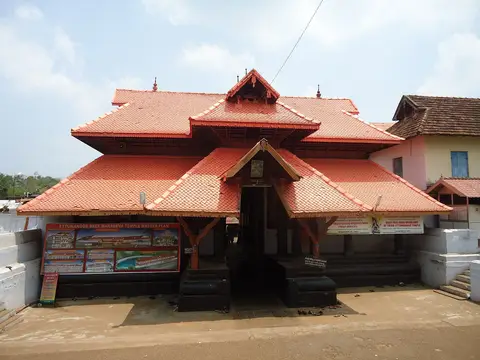 In the appEttumanoor Mahadeva Temple, EttumanoorEttumanoor, Kottayam district, Kerala